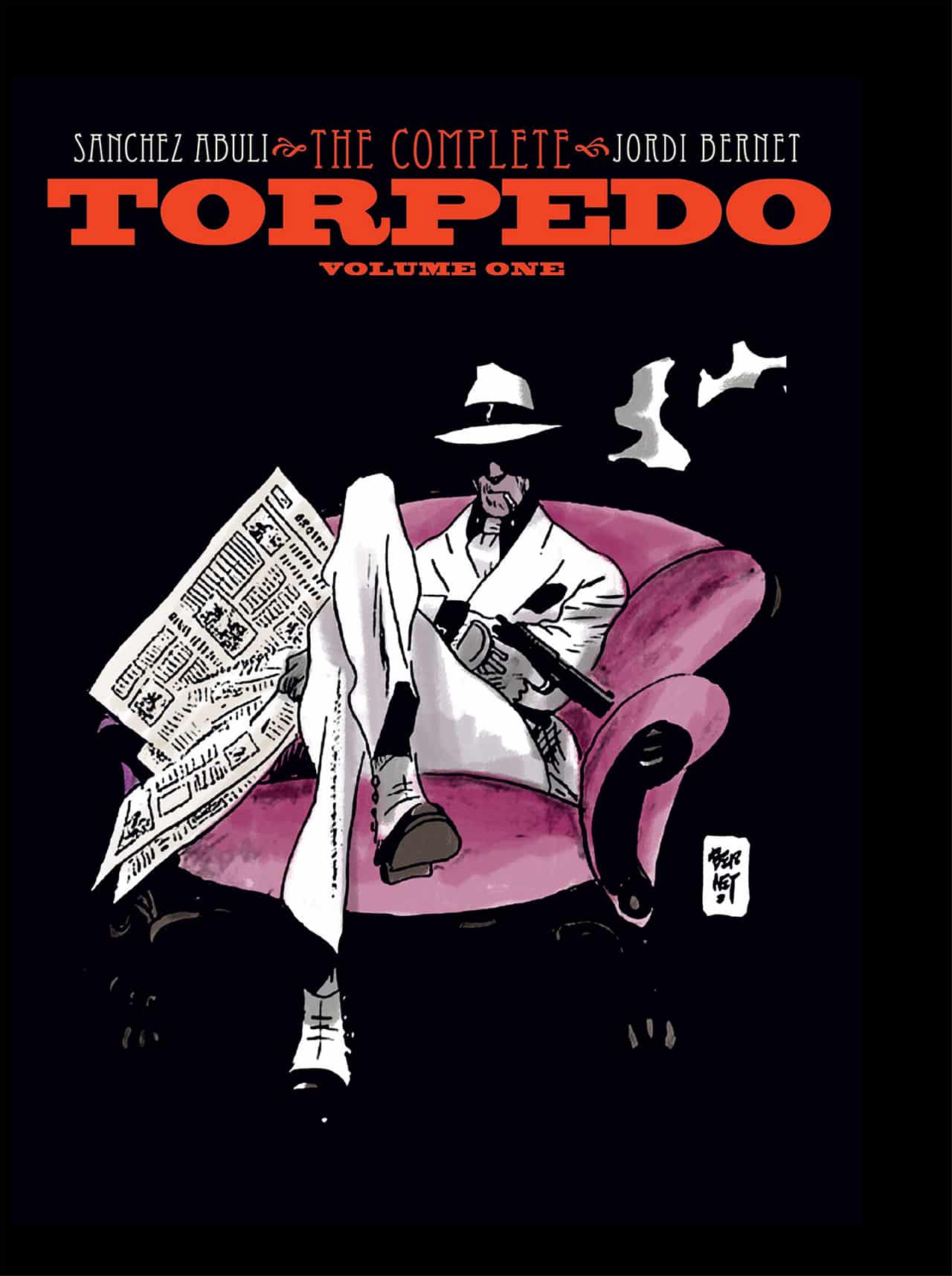
In the hazy smoke of an illegal bar in Manhattan, sometime around 1936, Luca Torelli lights another cigarette, his scar twitching like a bad memory as he waits for the next assignment. They call him Torpedo – cold, precise, an Italian-American hood in a pinstripe suit, the kind of guy who would shoot your mother for 500 dollars.
By Apostolos Kotsabasis
Enrique Sánchez Abulí conceived the comics hero Torpedo in Barcelona in the early ’80s. At first he collaborated with American artist Alex Toth, who drew the first two stories with strict, minimalist lines. Torpedo 1936 was first published in issue #32 of the Spanish horror magazine Creepy in February 1982. Shortly after, Toth quit – too much blood, too much rape, too many f-words in the dialogue. Toth wanted moral nuance; Abulí wanted nihilism, pure and without subtext.
Jordi Bernet took over after him, and everything clicked. His artwork is full of shadows and curves – women with endless legs, crooks with faces bordering on the grotesque, streets slick with rain reflecting lies in neon. Stylized noir, cinematic like a dream sequence from Scorsese, but harsher, more European, less emotional. Bernet draws violence like pornography: explicit, prolonged, almost beautiful.
Abulí’s scripts are the real poison – short, brutal episodes in which Torelli and his deformed sidekick Rascal take jobs from mobsters, betray everyone, and usually end up with the money or the girl or both, covered in someone else’s blood.

The dialogue is defined by vicious sarcasm and profanity; every line is a punch or a wordplay, delivered deadpan while bullets whistle all around. “Life is hard,” Torelli might say as he shoots some poor bastard in the head. Black humor of the kind that leaves you staring at the page, unsure whether to laugh or close the book.
The story is set during the Great Depression, because America was raw then – soup-kitchen lines, gangsters in Cadillacs, Prohibition turning everyone into hypocrites. There are no heroes here, only predators. The only recurring spark is Susan, that sly woman who outsmarts Torelli two, three times – a rare glimmer of punishment in a world where the amoral almost always win.
I read Torpedo when it was released by VAVEL noir sometime toward the end of the 20th century, back when comics still retained their aura and myth. Today, those issues – now rare – belong to private collections. Torpedo is not a novel of redemption. It is the comics equivalent of a mirror held up to the void – elegant and empty.
1
Torpedo 1936 is stylized noir, cinematic like a dream sequence from Scorsese, but harsher, more European, less emotional.
2
Luca Torelli and his deformed sidekick Rascal take jobs from mobsters, betray everyone, and usually end up with the money or the girl or both, covered in someone else’s blood.