by Christos Zabounis
The Fall of the House of York
Man’s first instinct is survival. After an exhausting delay, King Charles III was compelled to “sacrifice” his brother, twelve years his junior, in order to save the Throne of England.
19 February 1960. Queen Elizabeth II gives birth to her third child. Her firstborn is Charles (1948), her second is Anne (1950). According to a tradition dating back to the 15th century, the second son bears the title Duke of York, a junior branch of the English royal family that was defeated in the Wars of the Roses. “The baby is adorable. In any case, I am certain we shall all spoil him,” the Queen writes to her cousin. Which indeed happens. An average student at the same school attended by his father and his brother (Gordonstoun), Prince Andrew – named in honour of his grandfather, Prince Andrew of Greece – distinguishes himself early on for his charm, to the point of being dubbed the family’s “Robert Redford.” At the age of 18, the Palace announces that he will enlist in the Royal Navy. During the Falklands War he serves as a helicopter pilot in operations against the Argentine navy from the aircraft carrier *HMS Invincible*. After the British victory, he returns home crowned with the laurels of a hero.
His elder brother, Charles, heir to the Throne, watches all these years with bitterness as his mother openly displays her fondness for Andrew, while treating him with relative coolness. In the 1980s Andrew acquires the nickname “Randy Andy” – the “aroused” or, in greek katharevousa, the lascivious. His reputation as a playboy does not cease even after his marriage in 1986 to the red-haired Sarah Ferguson. Her father had been the polo coach of Andrew’s father, Prince Philip. They have two children together, Beatrice (1988) and Eugenie (1990). A photograph taken by a paparazzo in Saint-Tropez, showing the Duchess of York’s “financial adviser,” one John Bryan, kissing her toes, is published in the *Daily Mirror* in August 1992. Hmm. The couple had already separated in March of that year, but after the photo scandal reconciliation becomes impossible. The divorce is finalised in 1996. Royal observers had counted Andrew’s overnight stays at the family home—around 40 per year, due to his military obligations. Notably, the British press attacked only the “scandalous” Sarah with ferocity, leaving her husband largely unscathed.
After his retirement from the Navy in 2001, as a helicopter pilot instructor, the Duke of York – a title granted by his mother in 1986 – is appointed the United Kingdom’s Special Representative for International Trade and Investment. Meanwhile, he has restored relations with Sarah. They cohabit and jointly raise their two children. Around this time, rumours begin to circulate about his reckless spending during “professional” trips. “Government business seems to pass through ski slopes, golf courses and other exotic locations,” one could read on the BBC’s information page. His new friendships with Colonel Gaddafi’s son, Saif, or with the son-in-law of Tunisia’s President Ben Ali, intensify the questions. “Is it time to dispense with the services of the Duke of York?” asks Labour MP Chris Bryant aloud. And yet his mother protects him despite the outcry. Feeling invincible, he continues his luxurious and dissolute life.
The second dimension becomes known in 2011, when the ‘News of the World’ publishes a photograph of Andrew walking in Central Park with Jeffrey Epstein. The accompanying headline is blunt: “Prince Andy & the Paedo.” Indeed, in 2008 the American billionaire had been convicted of sexual exploitation of minors in Palm Beach. In March 2005, the parents of a 14-year-old girl reported to the police of the aristocratic resort that Epstein had paid their daughter for a “massage,” which turned into intercourse. After an extensive police investigation, it emerged that she was not the only victim. Dozens of cases came to light, yet, by some magic, the perpetrator was sentenced to only 18 months in prison. The judicial decision was fiercely contested by legal circles, and its re-examination led to Epstein’s re-arrest in 2019.
What, however, was a distinguished member of the royal family doing with a sex offender? “I went to tell him in person that we should end our relationship,” was his naïve reply. In the book “The Rise and Fall of the House of York”, published this year, historian Andrew Lownie offers his explanation: “It is clear that Epstein used Andrew. The prince was a useful idiot who provided him with respectability and access to political leaders, as well as commercial opportunities.” The same biography cites the following excerpt from an Epstein interview in 2007: “Andrew is my closest friend in the world (…) We are the same. Both addicted to sex. He’s the only person I know who is as obsessed with the vagina as I am. We shared the same women.”
On 9 August 2021, after Epstein’s suicide in prison, the New York authorities investigating the case published a photograph of Andrew holding Virginia Giuffre by the waist. Giuffre had brought a case in the American courts against Epstein, claiming that he forced her to have sexual relations with the prince in London in 2001, when she was 17, and that she subsequently slept with him twice more in New York and on the tycoon’s private Caribbean island. Another naïve response from the interested party: “Yes, I am in the photograph, but is that definitely my hand on her waist?”
In an attempt to defuse the situation, the Duke of York gives an interview to the BBC (see the series *A Very Royal Scandal*). There, he says he has “no recollection” of the minor and assures that he never met her. At the same time, he expresses no sympathy for the victims of his friend, who is in custody. The next day, everyone speaks of a fiasco, taking into account also his arrogant demeanour during the interview. Andrew is forced to withdraw from public life, but his mother continues to support him financially. And just when one might expect the storm to subside, Giuffre returns with a lawsuit—this time against the prince himself. The day after this development, the Queen strips her son of his military titles and royal patronages. The Palace announces that the Duke will defend himself as a private citizen.
Shortly before the celebration of Elizabeth’s Platinum Jubilee (70 years on the Throne), it becomes known that an out-of-court settlement has been reached with his accuser. Some sources estimate it at $12 million. Finished? Not at all. In December 2014, SIAC (Special Immigration Appeals Commission), a government body specialising in security-related immigration matters, announces a ban on the entry of Yang Tengbo into the country. Documents that come to light describe that the Chinese national suspected of espionage enjoyed an “unusual degree of trust” with Prince Andrew and had authorisation to act on his behalf in Chinese investment matters. One document states that the prince was in such a desperate state “that he would grab anything.” The Palace again distances itself with an awkward statement. Although there is no evidence that Andrew shared state secrets with Yang, nor did the investigation conclude with incriminating findings, his already damaged reputation is further burdened exponentially.
On 21 October of the current year, Virginia Giuffre’s book *Nobody’s Girl* is released. It describes in detail her sexual encounters with Prince Andrew. A few days after the British press pre-publishes excerpts concerning him, he himself – apparently under high-level guidance – announces his resignation from the title of Duke of York. In his statement, he notes that “the ongoing allegations against me are distracting from the work of the King and the Royal Family.” On 30 October, Buckingham Palace issues an official announcement stating that the 65-year-old prince will relinquish the lease of his 30-room royal residence, Royal Lodge; that all titles and honours will be removed; and that he will henceforth be referred to as Andrew Mountbatten-Windsor. “The sanctions,” it is noted, “were taken despite the fact that he continues to deny the allegations.”
What his mother did not dare to do, King Charles attempted, seeing the image of the Crown being tarnished – even if overall public opinion of the Royal Family remains positive, with Prince William and his wife Catherine enjoying approval ratings above 70%. Andrew’s corresponding rating prior to his ousting stood at 4–5%.

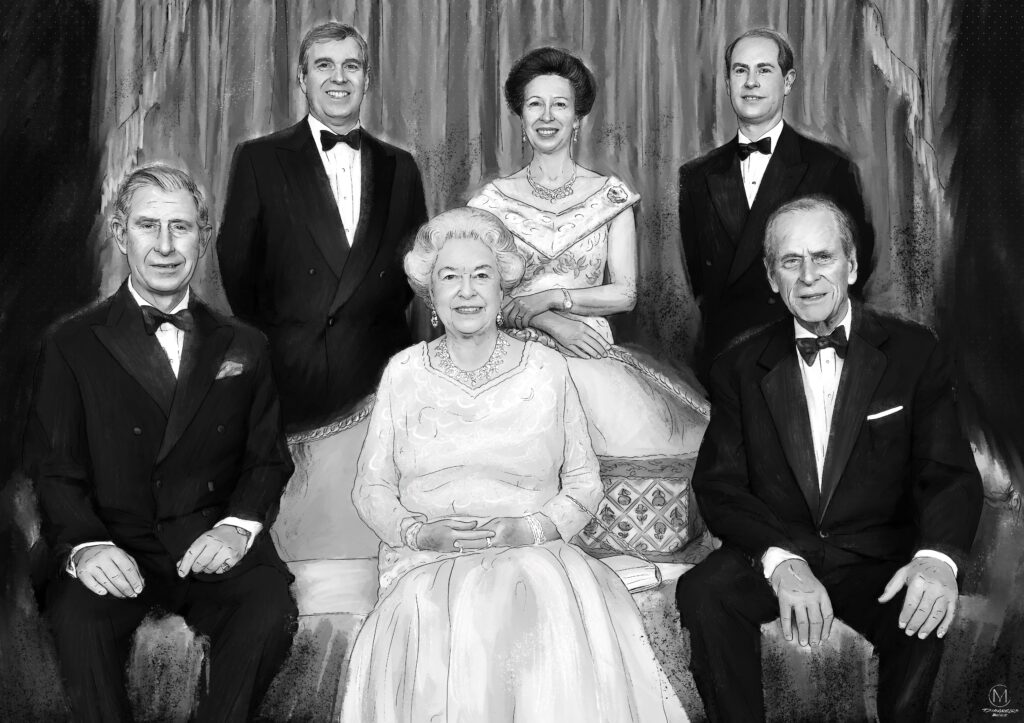
Illustrations by Dimitris Dimarelos
 Popular