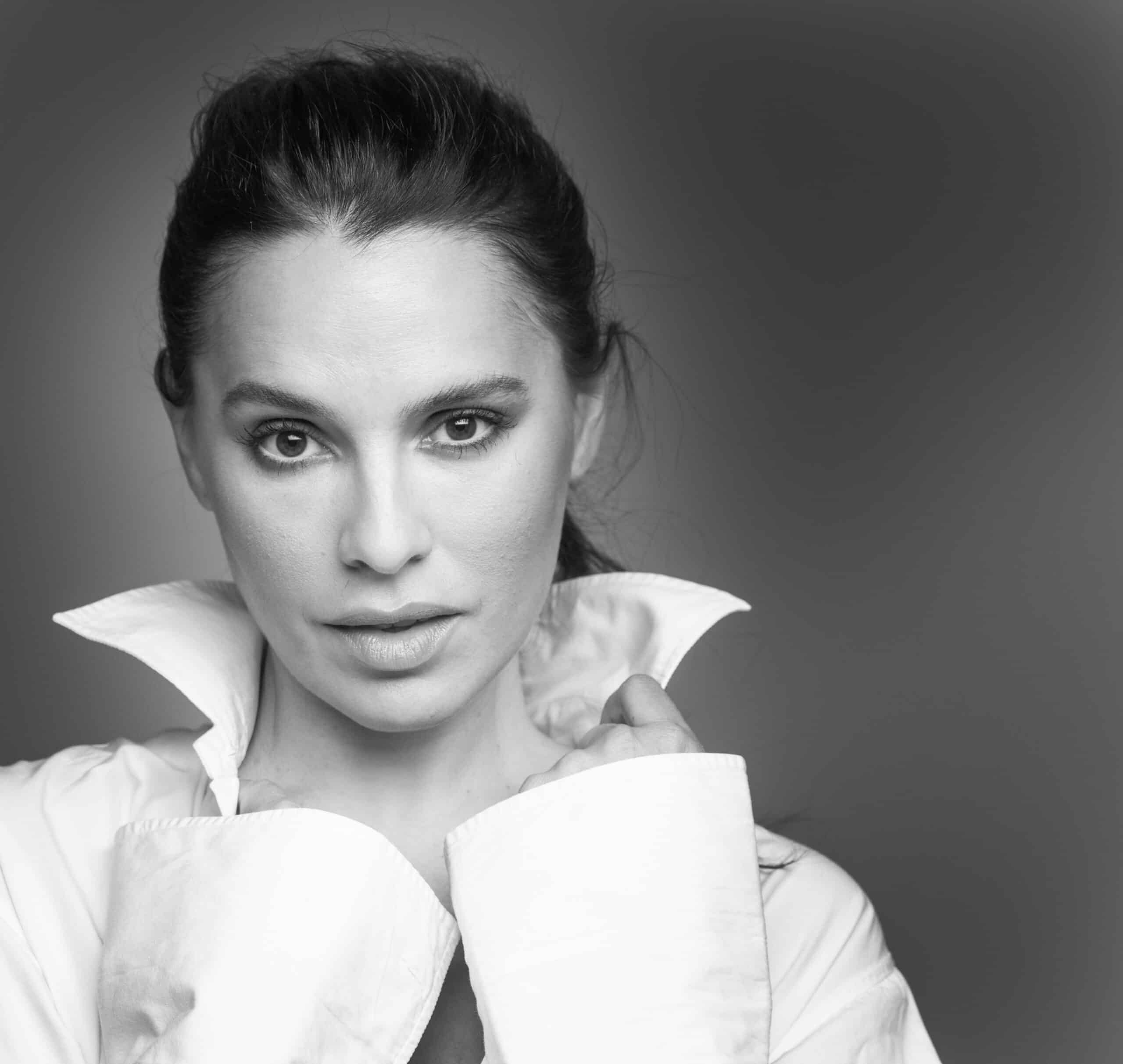
By Marianina Patsa
Photography: Tasos Vrettos
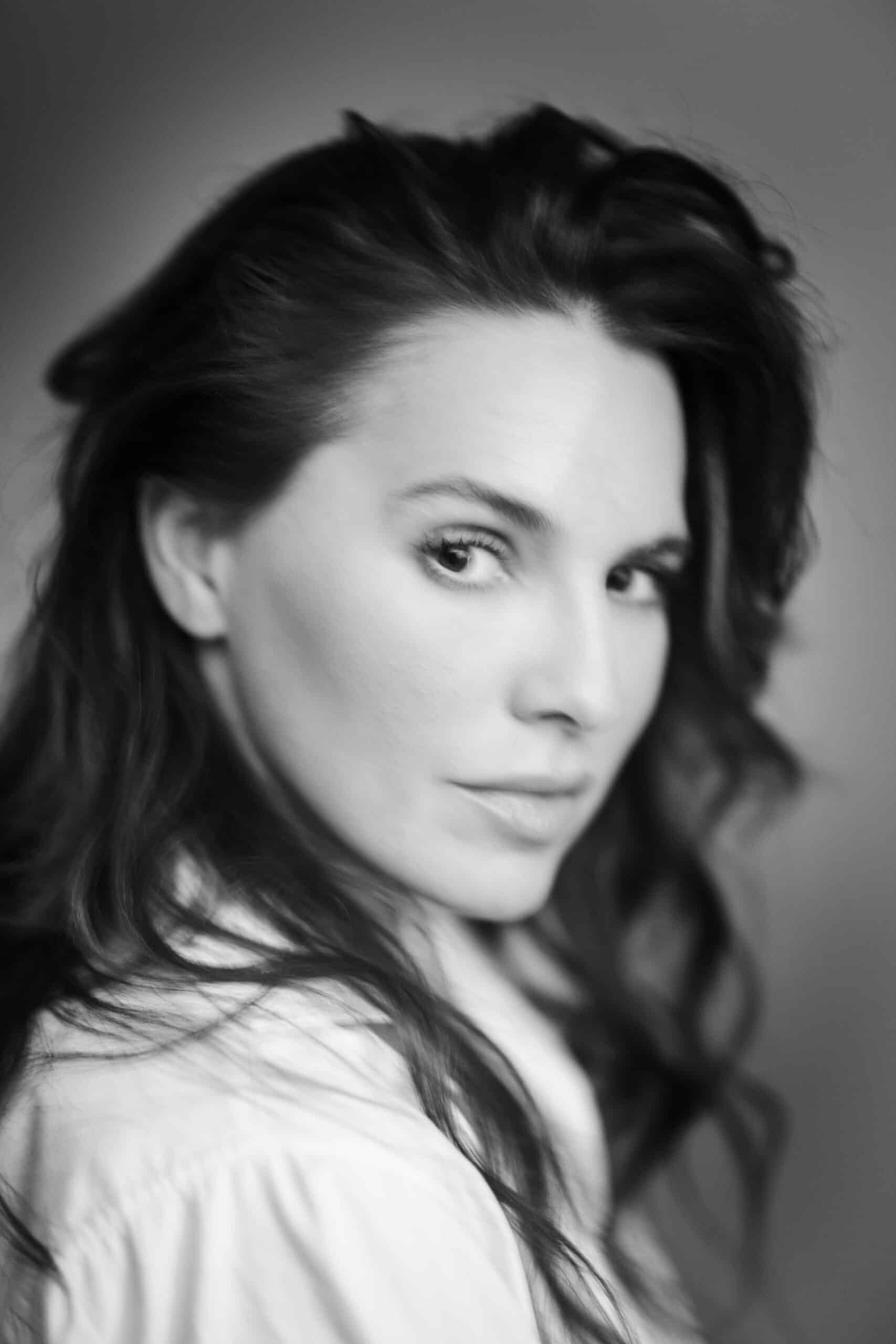
This is how Melia Kreiling, half Greek and half American, who initially set out to become a dancer before acting won her over, moves effortlessly between worlds, languages and artistic identities. She does not regard her different incarnations as something she needs to leave behind, but rather as parts of an identity that is constantly evolving. Perhaps this perpetual movement between the familiar and the unknown is ultimately the most consistent element of who she is.
In Guardians of the Galaxy, she appeared as a pink alien with unusual yellow eyes. In The Borgias, she starred alongside Jeremy Irons in a story centred on the powerful Renaissance dynasty. In The Bible, she took on the biblical role of Bathsheba, while in the political drama Tyrant, we saw her as a woman at the centre of events in a fictional Middle Eastern state. In Jez Butterworth’s Mammals, she became the mysterious wife of a chef who discovers that their marriage is not quite what he thought it was, while in Emily in Paris, she portrayed Sofia Sideris, a Greek visual artist caught up in an unexpected love triangle.
On the Greek television and film scene: In Pantelis Voulgaris’s The Last Note, she played Chara Lioudaki, in a story unfolding shortly before the execution of 200 Greeks in Kaisariani. In The Pantheons (Pantheoi), she took on the iconic role of Marmo, previously portrayed by Katia Dandoulaki in the first television adaptation of the novel, almost half a century earlier. Sick, the experimental film by The Callas (Lakis and Aris Ionas), was shot during the lockdown. It is a punk romance between two people living in different cities, trying to maintain their relationship amid isolation.
And so, through the characters she brings to life, Melia gets to experience many different lives. Driven by her need for change, we spoke with her about her work, the different versions of herself and the freedom of never having to remain the same.
– M.K. “I have been fortunate enough to find projects that are vastly different from one another. It is something I actively pursue, sometimes even to my own detriment, as I have to turn down certain projects that I might otherwise have accepted in order to create space and seek out something different.
Over the years, I have realised that this is absolutely essential to me. It satisfies a restless part of myself that needs to explore and take leaps into the unknown.”
Melia’s looks could easily have confined her to the role of the beautiful woman. Yet she refuses to let her appearance define her.
– M.K. “I have always instinctively rejected the notion of typecasting, simply because it is limiting. I feel suffocated when arbitrary reasons are imposed on me about what I can or cannot do. I am always a better person and a better professional when I move between different genres, budgets and mediums. It keeps my curiosity alive and makes me feel a little frightened, too — something that, when channelled in the right way, I believe can be a refreshing state of mind.
Of course, this means taking greater risks and experiencing longer periods of uncertainty. I have come to realise that, more often than not, it is worth it. So far, it has always taken me to exciting places.”
– You started out in dance before moving into acting, and you move with ease between entirely different genres of television and film. What is the hardest part about having to ‘kill’ an earlier version of yourself in order to move on to something new?
– M.K. “I like to hold on to all the different parts of myself. I keep them within me and bring them back to life whenever I miss them. I don’t like the idea of ‘killing’ anything. I simply prefer to add to who I am.
Everything I have learned throughout my life has proved useful at later stages, sometimes in ways I am not even consciously aware of. It enriches the way I think, approach ideas and people, as well as the way I solve problems. I also enjoy the freedom that comes with change.”
– You have a cosmopolitan career, yet Greece remains a constant point of reference. Is there anything about the international mindset that you would like to see more of in Greece? And, conversely, is there something about the Greek ‘madness’ or way of life that you would never trade for anything?
– M.K. “There are many inspiring, as well as frustrating, aspects on both sides. The details, however, change depending on what I feel I am missing or gaining.
One thing I find wonderful about Greece is the freedom to speak openly. There is still an acceptance that we all have different backgrounds, sensibilities and senses of humour, and that ‘nuances’ are particularly valued. I feel that this is somewhat lacking elsewhere.
On the other hand, I believe there is room for improvement when it comes to the organisation of everyday life in Greece, particularly in the workplace. I feel that sometimes there is a risk of ‘relaxed’ turning into ‘careless’.”
– You have lived and worked in London, Los Angeles, Paris and Athens. If you had to sum up your aesthetic identity in an everyday ‘uniform’, what would it look like? How much do your style and self-expression change depending on the city you are in?
– M.K. “There is a ‘base’: worn-in or well-loved jeans, quality walking shoes and a few tops to layer. Then I let my surroundings help me add the details. A statement jacket, a pageboy cap, a bag… My styling changes according to the atmosphere of each place and how it makes me feel. My favourite accessory for adapting is definitely sunglasses. The wonderful thing about travelling is that you get to observe the different light you encounter in every place. For me, light is what truly defines a city.”
If your life right now were a film, what genre would it belong to?
– M.K. “Right now? An existential comedy, in several languages!”